







Cooling is where a generator set most often fails: if the fans cannot move enough air on the hottest day of the year, the engine derates or shuts down exactly when power is needed. This page explains how radiator and charge-air cooler cooling works on gas and diesel generator sets, what decides the selection of the axial fans, and which SAVIO series are used, for standby and continuous duty.
How genset cooling works
Engine heat goes into the coolant and from there into the air, through two finned heat exchangers:
- The radiator on the high-temperature circuit, cooling the engine block and heads
- The charge-air cooler (intercooler) on the low-temperature circuit, cooling the turbocharged combustion air
The two cores are often stacked in series in the same airstream. Fans can be engine-driven or, increasingly, electric and independent, so they can be staged and speed-controlled by coolant temperature. In a draw-through (puller) layout the fan sits downstream of the cores and works in air already heated by the radiator: with 50 °C (122 °F) ambient it can reach 65–70 °C (150–160 °F).
What decides the fan selection
- Airflow from the heat rejection at full load and maximum ambient, corrected for air density at temperature and altitude. Step-by-step method and a worked example: Genset Radiator Fans: How to Size Airflow and Static Pressure.
- Static pressure of radiator, charge-air cooler, louvers and hoods, typically 200–350 Pa (0.8–1.4 in. w.g.) for a stacked cooling package, plus a margin for fouling.
- Noise, often the deciding limit: 65–70 dB(A) at 7 m (23 ft) with all fans running is common. Doubling the number of identical fans adds about 3 dB, so larger, slower fans with airfoil blades usually win.
- Speed control: EC motors with Modbus RTU or 0–10 V, or high-efficiency motors with VFD for higher powers; N+1 arrays keep running if one fan stops.
- Supply frequency: on 60 Hz a fan turns 20% faster, so it must be selected on 60 Hz curves. See 50 Hz vs 60 Hz Fans.
SAVIO series for generator sets
| Series | Diameter | Airflow | Features |
|---|---|---|---|
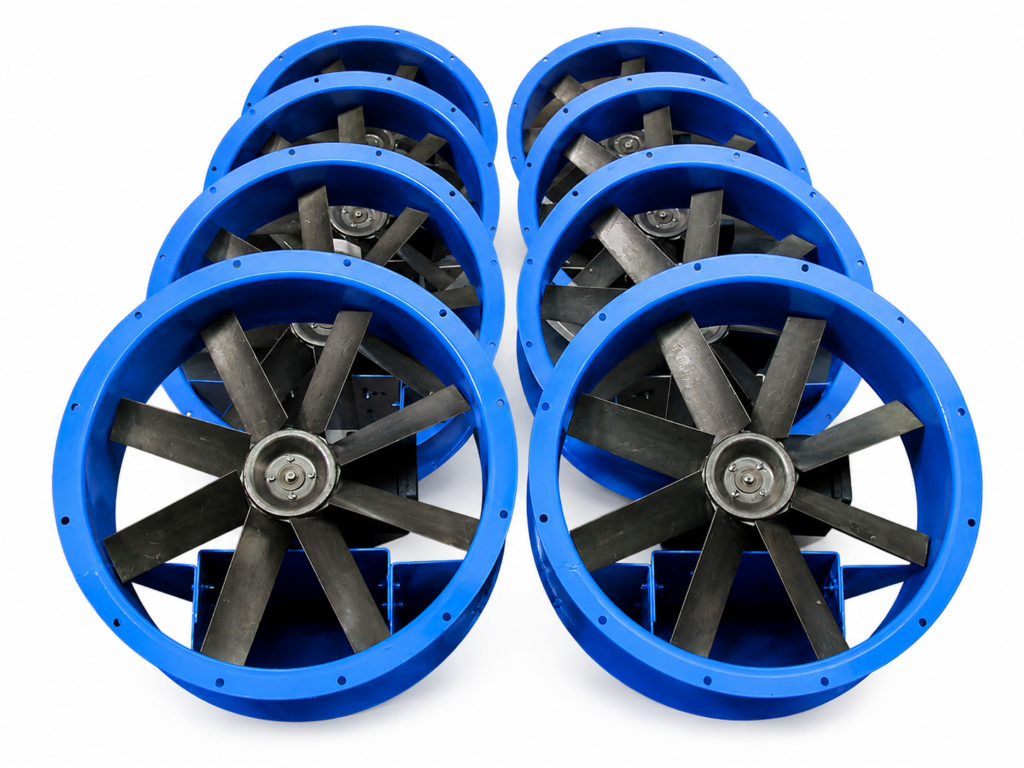
| SPM | 315–710 mm (12″–28″) | up to 33,600 m³/h (19,800 CFM) | Compact ducted fans for multi-fan arrays and enclosures |
| SPMD / SPMDR | 800–1,600 mm (31″–63″) | up to 150,000 m³/h (88,000 CFM) | Double-bearing tubeaxial fans for continuous outdoor duty |
| SI / SIR, SIT | 315–1,600 mm (12″–63″) | up to 150,000 m³/h (88,000 CFM) | Adjustable-pitch blades to match the operating point |
Larger diameters are built to project specifications, and ducted fans are available with downstream flow straighteners for vaneaxial duty: more static pressure and a more even flow across the cores. More in Tubeaxial vs Vaneaxial vs Propeller Fans.
Options
- ATEX execution up to zone 1/21 for gas-fuelled rooms and containers
- 50 and 60 Hz performance curves
- UL / CSA motors, NEMA or IEC frames, 460 V and 575 V
- IP55, class F insulation, motor sized for hot discharge air
- Static pressure up to 165 daPa (6.6 in. w.g.), ambient −20 to +50 °C (−4 to 122 °F)
Generator sets in data centers
Generator cooling is one of several fan applications in a data center, alongside heat rejection, electrical rooms and battery rooms. The overview is in Data center fans: where they are needed and how to choose them. For projects in North America see Industrial Axial Fans for the USA and Canada.
Do you have a specific genset application?
Share your operating point – flow rate (m3/h), static pressure, fan diameter, ambient temperature range – and our technical department will respond with a technical proposal and a quote.