
Most of the world runs on 50 Hz. The USA, Canada and part of Latin America run on 60 Hz. For a fan this is not a detail: the same impeller on the same motor turns 20% faster on 60 Hz, and airflow, pressure, power and noise all change with it. This guide explains what changes, why a 50 Hz fan must never simply be connected to a 60 Hz supply, and how to get a correct selection for North America.
1. Frequency sets the motor speed
The speed of an induction motor depends on the supply frequency and the number of poles:
Synchronous speed (rpm) = 120 × frequency (Hz) ÷ number of poles
Under load the motor runs a few percent below synchronous speed (the slip). Typical values:
| Poles | 50 Hz synchronous | 50 Hz typical at load | 60 Hz synchronous | 60 Hz typical at load |
|---|---|---|---|---|
| 2 | 3,000 | ≈ 2,900 | 3,600 | ≈ 3,500 |
| 4 | 1,500 | ≈ 1,450 | 1,800 | ≈ 1,750 |
| 6 | 1,000 | ≈ 960 | 1,200 | ≈ 1,160 |
| 8 | 750 | ≈ 720 | 900 | ≈ 870 |
2. The fan laws: what happens at 20% more speed
For the same fan and the same air density, performance follows the fan laws:
- Airflow changes with speed: CFM₂ = CFM₁ × (N₂ ÷ N₁)
- Static pressure changes with the square of speed: SP₂ = SP₁ × (N₂ ÷ N₁)²
- Power changes with the cube of speed: HP₂ = HP₁ × (N₂ ÷ N₁)³
- Sound power rises by about 50 × log₁₀(N₂ ÷ N₁) dB
Example
A 4-pole fan selected on 50 Hz delivers 20,000 CFM at 1.0 in. w.g. at 1,450 rpm and absorbs 6 HP. Connected to 60 Hz, it turns at about 1,750 rpm (ratio 1.21):
| Quantity | 50 Hz | 60 Hz | Change |
|---|---|---|---|
| Speed | 1,450 rpm | 1,750 rpm | +21% |
| Airflow | 20,000 CFM | ≈ 24,100 CFM | +21% |
| Static pressure | 1.0 in. w.g. | ≈ 1.46 in. w.g. | +46% |
| Absorbed power | 6 HP | ≈ 10.5 HP | +76% |
| Sound power | reference | ≈ +4 dB |
The fan now moves more air than needed, the motor is badly overloaded, the impeller tip speed may exceed its mechanical limit, and the unit is noticeably louder. More airflow is not a bonus: the motor and the impeller were never designed for it.
3. Three correct ways to handle 60 Hz
- Reselect on 60 Hz curves. The fan is chosen again for the required operating point at 60 Hz speed. This often means a different diameter or a different number of poles: a 6-pole motor at about 1,160 rpm on 60 Hz turns roughly 20% slower than a 4-pole on 50 Hz.
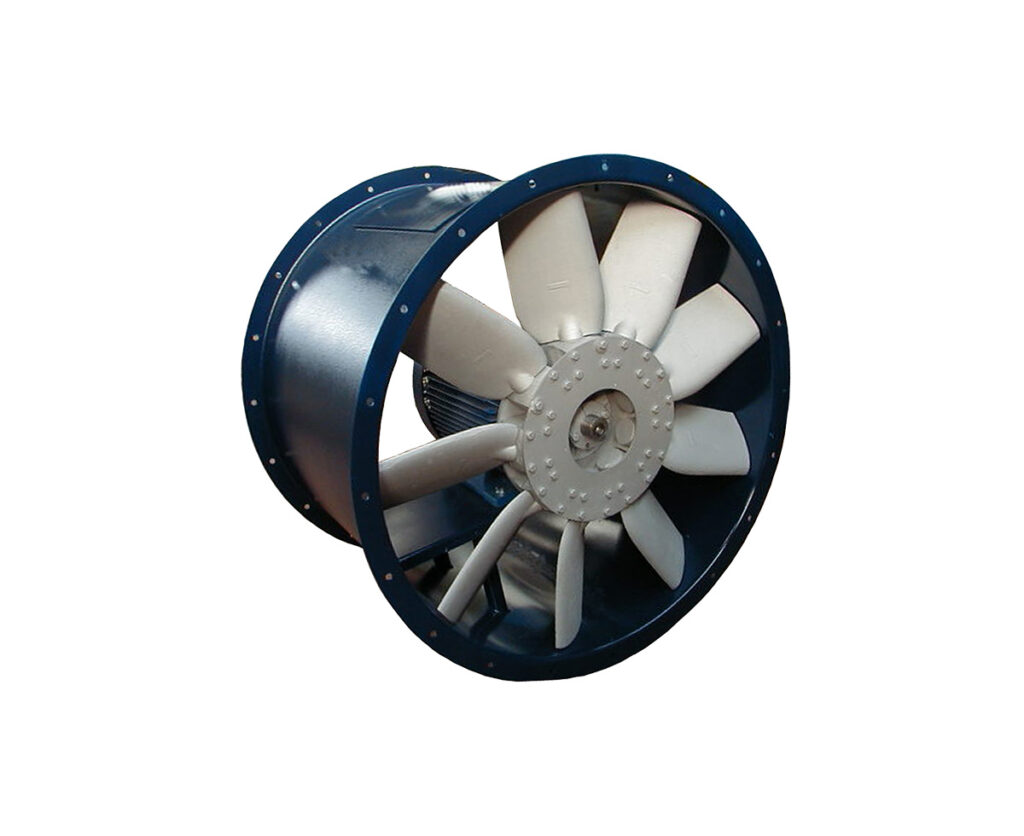
- Adjust the blade pitch. On adjustable-pitch axial fans such as SI / SIR, a lower blade angle brings airflow and power back to the design point at 60 Hz speed, with the same impeller and housing.
- Use a VFD. A variable frequency drive can run the fan at the speed it needs, regardless of the supply. The motor must be inverter-duty and the drive must be included in the scope and the price.
What is not acceptable: shipping a 50 Hz selection and connecting it to a 60 Hz supply, hoping the motor will cope.
4. Motors for the USA and Canada
| Item | What to check |
|---|---|
| Voltage | USA: 460 V three-phase is the standard industrial voltage (208 V and 230 V on smaller units). Canada: 575 V is common in industrial plants. |
| Listing | Motors UL or CSA listed (cURus / CSA marking) for acceptance by inspectors and OEM customers. |
| Efficiency | US DOE rules (10 CFR Part 431) set premium efficiency levels for most general-purpose motors. Check whether your application is covered. |
| Enclosure | TEFC for outdoor or dusty duty; IP55 is the usual IEC equivalent. |
| Frame | NEMA-frame or IEC-frame motors. Many OEMs accept IEC frames with UL / CSA listing; where the specification calls for NEMA motors, they are available. |
| Service factor | NEMA motors are often rated with a 1.15 service factor, IEC motors usually 1.0. Size the motor on the fan power, not on the service factor. |
| VFD duty | For drive operation, inverter-duty insulation according to NEMA MG 1 Part 31. |
5. Performance data and testing
Specifications in North America often refer to fan performance tested according to AMCA 210 (airflow and pressure) and AMCA 300 (sound). Ask your supplier for curves at 60 Hz speed and at your air density, and for the test basis behind them. If a project specification requires the AMCA Certified Ratings Seal, make it clear at the inquiry stage, because it is a separate certification program.
6. Checklist when converting a 50 Hz project to 60 Hz
- Required airflow and static pressure at site conditions (not the 50 Hz values scaled up)
- Air temperature, altitude and resulting density
- Supply voltage and frequency; direct-on-line or VFD
- Motor listing (UL / CSA), efficiency class, enclosure and frame standard
- Maximum allowed sound level at a given distance
- Space available: diameter, length, mounting
- Hazardous area classification, if any
How SAVIO handles North American projects
SAVIO has built industrial fans in Italy since 1945. For the USA and Canada we select every fan on 60 Hz performance curves, supply UL / CSA motors at 460 V and 575 V, in NEMA or IEC frames, and verify performance in our in-house test room built to AMCA standards. Our axial fans cover 12″ to 63″ and up to 88,000 CFM per unit, with adjustable-pitch blades on the SI / SIR series to match the operating point exactly.
See also Genset Radiator Fans: How to Size Airflow and Static Pressure, Tubeaxial vs Vaneaxial vs Propeller Fans and our page Industrial Axial Fans for the USA and Canada.
Converting a project to 60 Hz?
Send us the operating point and the supply voltage: we will reply with a 60 Hz selection and a quote.