
A generator set is only as reliable as its cooling system. If the radiator fans move too little air at the hottest hour of the year, the engine derates or shuts down, exactly when the standby power is needed. This guide shows how to size genset radiator fans in US units: the airflow you need, the static pressure the fans must overcome, and what changes when the fans run on 60 Hz.
1. Start from the heat rejection
Everything begins with the heat the cooling package must reject to air. The engine manufacturer gives it on the data sheet, usually split into two circuits:
- Jacket water (high-temperature circuit), the heat removed from the engine block and cylinder heads
- Charge-air cooler or aftercooler (low-temperature circuit), the heat removed from the compressed combustion air on turbocharged engines
Add the circuits that share the same radiator and fans. Use the value at full load and maximum ambient, not the nominal figure, and convert it to BTU/hr: 1 kW = 3,412 BTU/hr.
2. Calculate the airflow
The airflow follows from an energy balance on the air side. For air at standard density (0.075 lb/ft³, 70 °F, sea level):
CFM = Heat rejection (BTU/hr) ÷ (1.08 × ΔT)
Here ΔT is the air temperature rise across the radiator in °F, and 1.08 = 60 min/hr × 0.075 lb/ft³ × 0.24 BTU/lb·°F. The radiator maker sets ΔT together with the core size: a smaller ΔT means a bigger core and more air, a larger ΔT means a smaller core but hotter coolant.
Correct for temperature and altitude
Fans move volume, but air carries heat by mass. On a hot day or at altitude each cubic foot weighs less, so you need more CFM to carry the same heat. Divide the standard CFM by the density ratio:
Density ratio = [530 ÷ (460 + T °F)] × [barometric pressure ÷ 29.92 in. Hg]
| Condition | Density ratio |
|---|---|
| 70 °F, sea level | 1.00 |
| 104 °F, sea level | 0.94 |
| 122 °F, sea level | 0.91 |
| 122 °F, 1,000 ft | 0.88 |
| 122 °F, 5,000 ft | 0.76 |
Worked example
A natural gas generator set rejects 900 kW through a combined jacket water and aftercooler radiator. The design air temperature rise is 36 °F, the maximum ambient is 122 °F and the site sits at 1,000 ft.
- Heat rejection: 900 kW × 3,412 = 3,070,800 BTU/hr
- Standard airflow: 3,070,800 ÷ (1.08 × 36) ≈ 79,000 CFM
- Density correction: 79,000 ÷ 0.88 ≈ 90,000 CFM at site conditions
- Fan arrangement: four fans of about 22,500 CFM each, plus a fifth as standby for N+1 redundancy
3. Add up the static pressure
The fans must overcome every resistance in the air path. Ask each supplier for the pressure drop at the design airflow, then add them up:
| Component | Typical range (in. w.g.) |
|---|---|
| Radiator core | 0.3 – 0.8 |
| Intake louvers, screens, filters | 0.1 – 0.3 |
| Discharge damper, hood or duct | 0.1 – 0.4 |
| Sound attenuators, if any | 0.2 – 0.5 |
In the example, a core at 0.50 in. w.g., intake louvers at 0.20 and a discharge hood at 0.25 give 0.95 in. w.g. Add a margin of 10 to 15% for fouling and installation effects, and select the fans for about 1.05 in. w.g. at 22,500 CFM each. The ranges above are typical values only: always use the figures of your own components.
Watch out for hot air recirculation. If discharge air finds its way back to the intake, the real inlet temperature rises and the whole calculation fails. Discharge and intake must be well separated, especially in enclosures and on rooftops.
4. Pusher or puller, one fan or an array
- Puller (draw-through): the fan sits downstream of the radiator and pulls air through it. The air reaching the core is more uniform, but the fan works in hot air.
- Pusher (blow-through): the fan blows ambient air into the radiator. The fan and motor run cooler, which helps in high ambient sites.
- Fan arrays: several smaller fans instead of one large fan allow N+1 redundancy, staging at part load and easier replacement. They suit data center gensets, where a single fan failure must not stop the unit. For high-resistance systems, see Tubeaxial vs Vaneaxial vs Propeller Fans.
5. What changes on 60 Hz
A fan selected on a 50 Hz curve does not behave the same on a 60 Hz supply. Motor speed rises by 20%, from about 1,450 to about 1,750 rpm for a 4-pole motor, and the fan laws do the rest:
| Quantity | Fan law | 50 Hz fan run at 60 Hz |
|---|---|---|
| Airflow | ∝ speed | +20% |
| Static pressure | ∝ speed² | +44% |
| Power | ∝ speed³ | +73% |
The extra power can overload the motor and overstress the impeller. That is why a fan for North America must be selected on 60 Hz performance curves, with a motor sized for that speed, and not converted from a 50 Hz selection. More on this in 50 Hz vs 60 Hz Fans: What Changes When a Fan Runs in North America.
For the USA and Canada, also check the motor listing (UL or CSA), the supply voltage (460 V in the USA, 575 V in much of Canada), an IP55 / TEFC enclosure for outdoor duty, and inverter-duty insulation if the fans run on VFDs.
6. Checklist: what to send your fan supplier
- Heat rejection per circuit, at full load and maximum ambient
- Maximum ambient temperature and site altitude
- Radiator core face area and pressure drop at design airflow
- Available space: maximum fan diameter and number of fans
- Arrangement: pusher or puller, horizontal or vertical discharge
- Supply: voltage, 60 Hz, VFD or direct-on-line
- Redundancy requirement (N+1) and noise limits at a given distance
- Hazardous area classification, if any
SAVIO axial fans for genset cooling
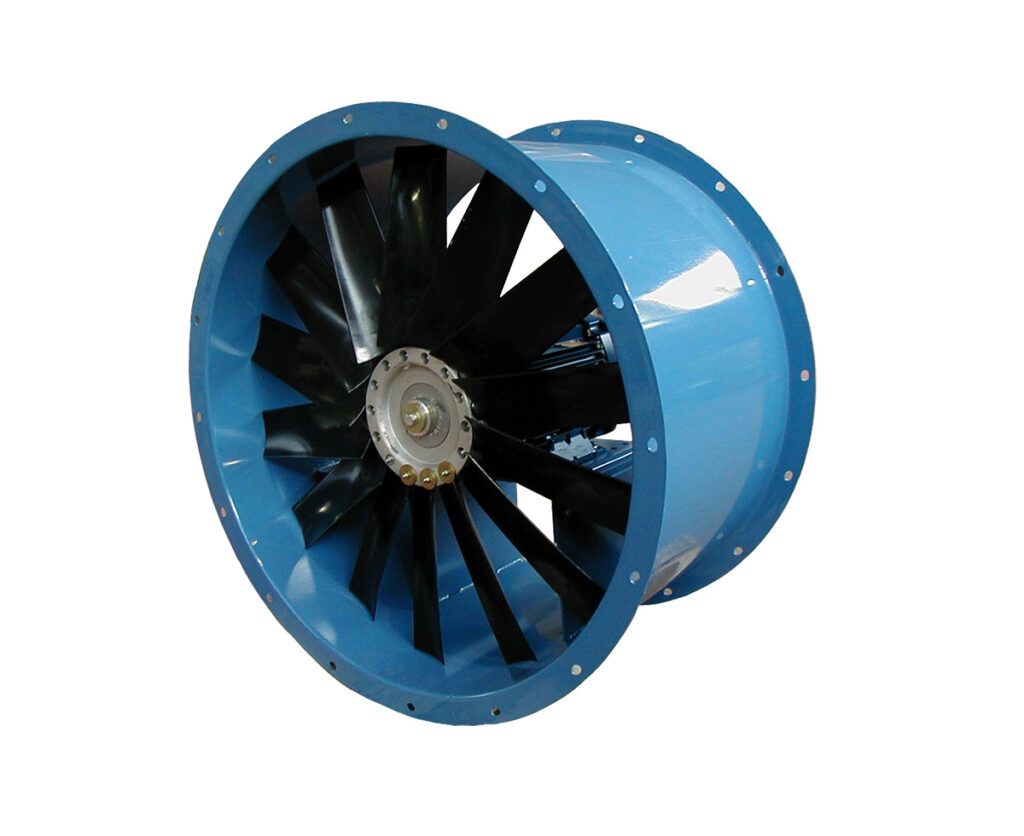
SAVIO has built industrial axial fans in Italy since 1945. For genset radiators and charge-air coolers we offer SPM compact ducted fans (12″ to 28″), SPMD / SPMDR double-bearing tubeaxial fans (31″ to 63″) and SI / SIR adjustable-pitch fans, up to 88,000 CFM per unit. For North American projects we supply 60 Hz curves, UL / CSA motors at 460 V and 575 V, and performance verified in our in-house test room built to AMCA standards.
More on the application in Axial fans for genset cooling and Data center fans: where they are needed and how to choose them.
Send us your operating point
Airflow, static pressure, ambient and altitude: our engineers will reply with a 60 Hz selection and a quote.