
Axial fans come in three families: propeller, tubeaxial and vaneaxial. They look similar, but they handle pressure, efficiency and airflow quality very differently. For radiator, dry cooler and heat exchanger cooling, picking the right family decides whether the system reaches its design airflow on the hottest day, and how much power it burns doing so.
The three families at a glance
| Type | Construction | Typical static pressure | Efficiency | Typical uses |
|---|---|---|---|---|
| Propeller | Impeller in a mounting ring or panel, no housing | up to about 1 in. w.g. | Low to medium | Wall exhaust, free-discharge condensers, simple radiator shrouds |
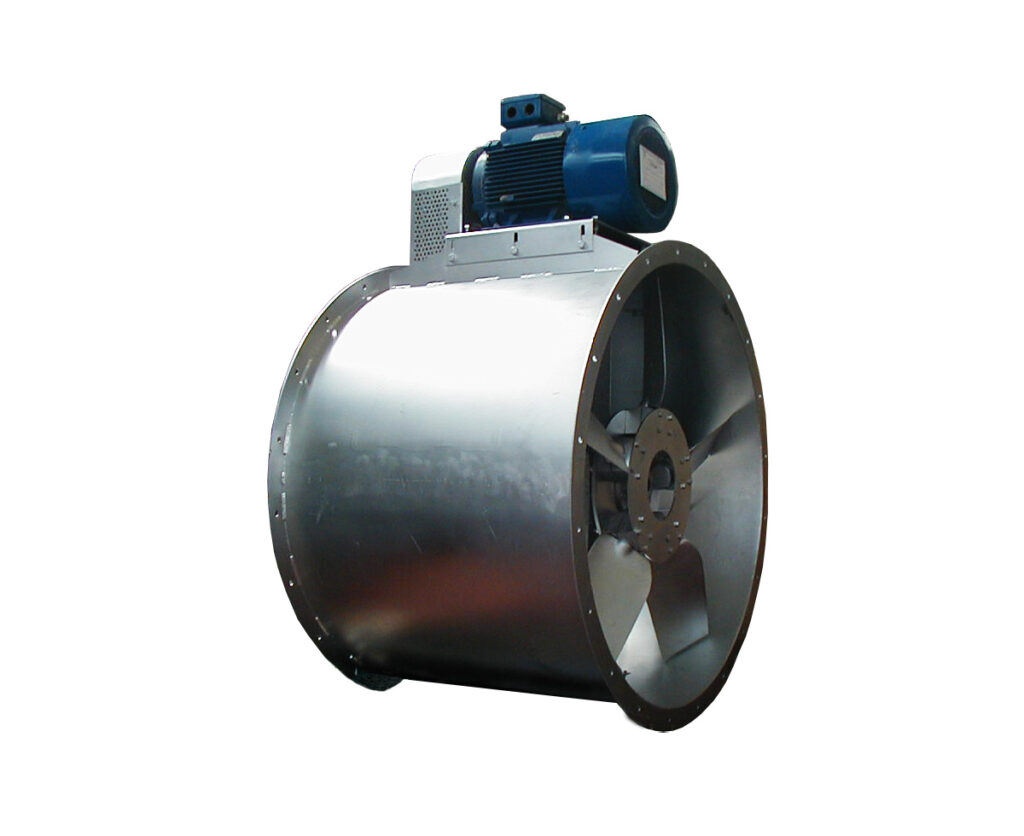
| Tubeaxial | Impeller in a cylindrical housing (duct) | up to about 2–3 in. w.g. | Medium | Ducted ventilation, genset radiators and enclosures, tunnels |
| Vaneaxial | Cylindrical housing plus guide vanes (flow straighteners) | up to about 6 in. w.g. and beyond in special designs | Highest of the three | Systems with louvers, attenuators or long ducts, 24/7 cooling, process air |
The pressure ranges are indicative: the real limit depends on diameter, speed and blade design. Always select on the manufacturer’s curves.
What the guide vanes actually do
An axial impeller pushes the air forward, but it also sets it spinning. In a tubeaxial fan that rotation, the swirl, leaves the housing and is lost: it is energy the motor paid for that never becomes static pressure.
A vaneaxial fan adds a row of fixed vanes behind the impeller. The vanes turn the swirling flow back into straight axial flow and convert part of its energy into static pressure. The result is:
- More static pressure from the same impeller and speed
- Higher efficiency, so less power for the same duty
- Straighter, more uniform discharge, which matters when a coil or radiator sits right after the fan
Which one for radiator and heat exchanger cooling
Low resistance: propeller or short tubeaxial
A radiator with a simple shroud, free intake and free discharge often sees less than 0.5 in. w.g. A propeller fan or a short tubeaxial fan is enough, and the simplest solution is usually the cheapest.
Enclosures and containers: tubeaxial
Generator sets in enclosures or ISO containers add intake louvers, screens and a discharge hood. Total resistance typically lands between 0.8 and 2 in. w.g. Ducted tubeaxial fans handle this range well, and arrays of several fans give redundancy.
High resistance or blow-through coils: vaneaxial
Choose a vaneaxial fan when the system adds sound attenuators, long discharge ducts or filters, when the pressure climbs toward 2 in. w.g. and above, or when the fan blows directly into a coil and needs an even velocity profile across the face.
24/7 duty: count the energy
On fans that run all year, efficiency pays back quickly. Example: a fan absorbing 30 HP at 70% efficiency, improved to 78% with guide vanes, needs about 3 HP less for the same duty. Over 8,760 hours that is about 20,000 kWh per year, or around $2,000 at $0.10 per kWh, for each fan.
Other choices that matter
- Adjustable-pitch blades let the fan match the real operating point exactly, and help when a 50 Hz design moves to 60 Hz
- Direct drive keeps maintenance low; belt drive allows speed changes without a VFD
- Motor: UL / CSA listed, NEMA or IEC frame, 460 V or 575 V, TEFC, inverter-duty if a VFD is used
- Sound: leave enough distance between impeller and vanes, and check the sound data at 60 Hz speed
Checklist before you specify
- Airflow at site conditions and total static pressure, component by component
- Distance between fan and coil, and whether the fan pushes or pulls
- Duty cycle: standby, prime or continuous
- Space: diameter and length available, mounting position
- Supply voltage, 60 Hz, VFD or direct-on-line
- Sound limits and hazardous area classification, if any
SAVIO tubeaxial and vaneaxial fans
SAVIO builds ducted axial fans in Italy since 1945: SPM compact ducted fans (12″ to 28″), SPMD / SPMDR double-bearing tubeaxial fans (31″ to 63″), and SI / SIR and SIT fans with high-efficiency aluminum impellers, up to 88,000 CFM per unit. Our ducted fans are available with downstream flow straighteners for vaneaxial duty.
For North America we select on 60 Hz curves, supply UL / CSA motors in NEMA or IEC frames at 460 V and 575 V, and verify performance in our in-house test room built to AMCA standards. Read also Genset Radiator Fans: How to Size Airflow and Static Pressure and 50 Hz vs 60 Hz Fans.
Tubeaxial or vaneaxial for your system?
Send us airflow, static pressure and layout: we will recommend the right configuration with 60 Hz data and a quote.