








A data center never stops, and neither does the heat that must be dissipated. Server rooms have their own precision air conditioning units; however, all around them, industrial fans work to keep generators, heat exchangers, and technical rooms at the right temperature. If one of these stops, the plant loses a piece of its service continuity.
In this guide, we look at where they are needed, which data matters for selection, and which SAVIO series are suitable.
Where industrial fans are needed in a data center
1. Cooling of generator sets
Emergency and continuous duty generators dissipate engine heat through radiators and intercoolers. Axial fans must push large volumes of air through the finned coils, even under extreme external temperatures. We discuss this in detail in the article on axial fans for generator set cooling.
2. Heat dissipation: dry coolers and heat exchangers
Heat removed from server rooms is released outside through air-cooled heat exchangers. Here, banks of side-by-side axial fans operate: multiple machines in parallel provide high flow rates, allow for capacity modulation, and maintain service even if one unit stops.
3. Ventilation of technical rooms
Transformer stations, UPS rooms, electrical panels, and pump rooms continuously dissipate heat. Ventilation sized for the actual heat to be removed prevents overheating and extends equipment life.
4. Battery rooms
During charging, certain types of batteries can develop hydrogen. These rooms require dedicated ventilation and, where risk assessment demands it, fans in ATEX execution.
How to choose the fan
- Actual operating point: flow rate and static pressure calculated with all system pressure drops (finned coils, grilles, dampers, silencers), not based on nameplate data.
- Air temperature and density: the fan must guarantee the flow rate at the maximum design outdoor temperature and at the installation altitude.
- Redundancy: multiple fans in parallel, with a standby machine, to avoid dependence on a single component.
- Continuous duty: 24/7 operation, with construction, motor, and bearings sized for this use.
- Regulation: adjustable blades allow the fan to be adapted to the actual operating point of the plant.
- Noise level: in installations near residential areas, silencers and soundproof cabins are used.
- Power supply and protection: voltage and frequency of the installation country (50 or 60 Hz) and an adequate degree of protection for outdoor use.
SAVIO series for data centers
| Series | Diameters | Flow rate | Typical use |
|---|---|---|---|
| SPM | 315 – 710 mm | 240 – 33,600 m³/h | Compact ducted axial fans, for banks of multiple fans and confined spaces |
| SPMD / SPMDR | 800 – 1,600 mm | up to over 120,000 m³/h | Double-support ducted axial fans, for high flow rates and continuous outdoor installations |
| SI / SIT | 315 – 1,600 mm | according to configuration | Adjustable aluminum alloy blades, to precisely hit the operating point |
- Static pressure up to 165 daPa
- Ambient temperature from −20 to +50 °C
- Three-phase power supply 380–480 V, 50/60 Hz, class F insulation
- Protection degree IP54 / IP55
- CE marking; ATEX execution available across the entire range
The catalog range reaches 1,600 mm in diameter, with motors up to 55 kW. For even higher flow rates, we manufacture larger diameter ducted axial fans, sized to project specifications.
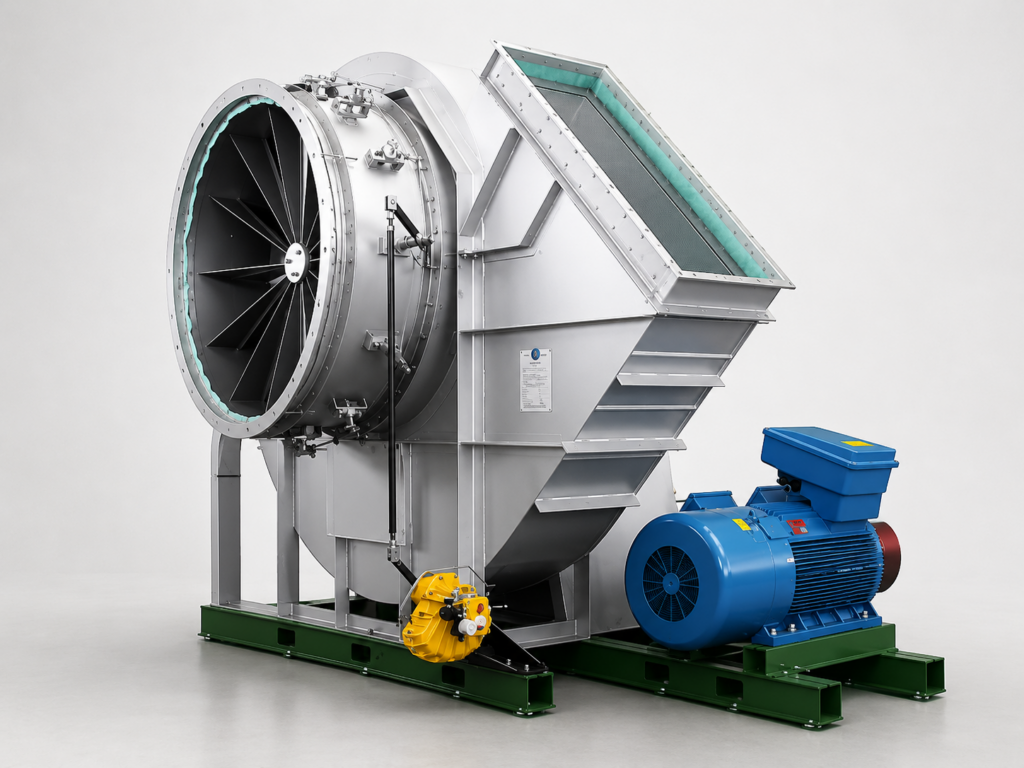
Where pressure drops are higher, for example with long ducting or filtering sections, low and medium pressure centrifugal fans are used.
For manufacturers and designers
We work with manufacturers of generator sets, heat exchangers, and plants, as well as with design firms: we size the fan to the actual operating point and, when necessary, create customized configurations for integration into the machine. Send us the flow rate, pressure, temperature, and available dimensions: we will respond with a technical proposal.